The worst time to choose a restaurant in New York is ten minutes after a show ends, when everyone is hungry, half the group is pretending not to care, and the first person who says “I’m fine with anything” is absolutely not fine with anything.
A generic “best restaurants near me” list does not help much in that moment. It may be useful at 3 p.m. with a laptop open, but after a concert, play, comedy set, or late movie, the problem is narrower. You are not choosing the best restaurant in the neighborhood. You are choosing the right next move for this group, from this location, before closing time becomes the real decision-maker.
That is where the Shortlist Method works better than ranking-hopping.
Start with the constraints instead of the cuisine. The useful first message is not “best dinner near me.” It is something closer to: “We are four people leaving a show near Union Square at 10:20 p.m. One person is vegetarian, one wants something quiet enough to talk, and we need a place that still has food service after 11. Give me three realistic options and tell me why each fits.”
That message does three things. It names the time pressure, the group constraints, and the decision standard. It also keeps the answer small enough to use while walking down the sidewalk.
The shortlist should only have three options. More than that turns back into research, and research is how people end up standing outside a theater arguing over menus on tiny screens. Three is enough to compare without making the night feel like a committee meeting.
The first option can be the safest fit: close, likely flexible, broad menu, low drama. The second can be the better-vibe option: maybe a little farther, but more suitable if the group wants to keep the night going. The third can be the fallback: the place to choose if reservations are gone, the kitchen is closing, or the group is losing patience.
The next step is the part most people skip: ask for the reason, not just the names. A good shortlist should explain tradeoffs in plain language. “Pick this if conversation matters.” “Pick this if speed matters.” “Pick this if the vegetarian constraint is the hardest one.” That reasoning is more useful than a star rating because it connects the recommendation to the actual social problem.
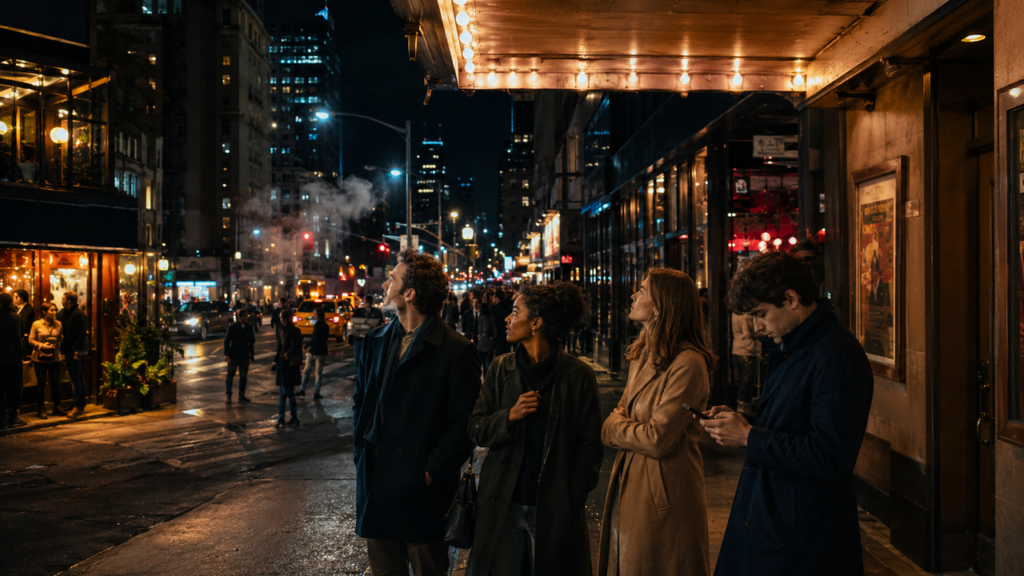
Only after that does the next action matter. The follow-up should be practical: “Which one should we text first?” or “Which one is safest if we are arriving in 20 minutes?” or “Give me a message I can send asking whether the kitchen is still open.” This is the point where an iMessage-based assistant makes sense, because the decision is already happening in a thread, with people reacting in real time. For a night-out planner who needs picks shaped around the group and the clock, Karpo for city planning fits best after the group has named the constraints and needs a usable shortlist, not a generic ranking.
The important guardrail is that late-night facts change. Hours can shift. A kitchen may close before the posted closing time. A table that looked available five minutes ago may disappear. Prices, noise level, and reservation rules can vary by night. Treat every shortlist as a decision aid, not a guarantee.
A clean post-show flow looks like this:
“Four of us just left a show near [venue/neighborhood]. We want dinner or drinks with real food. One vegetarian. Not too loud. We can walk 15 minutes or take a short ride. It is [current time]. Give us three options: safest, best vibe, and fallback. For each one, say why it fits and what we should verify before going.”
That prompt is not elegant, but it is useful. It gives the assistant enough context to make a city decision instead of producing a search result.
The Shortlist Method works because it respects the actual shape of the night. Nobody wants to optimize forever after a show. They want to keep the group moving, avoid the obvious mistakes, and land somewhere that still feels like part of the evening rather than a compromise made under fluorescent lighting.
The goal is not to find the best place in New York. The goal is to find the place that still works for these people, at this hour, with this much energy left.